Category Archives: Uncategorized

Questions I Didn’t Answer 1

As a guest writer on LeAnna Shields’s podcast,The Cozy Sleuth, to talk about the second book in my Leah Contarini Mysteries (If Two of Them Are Dead). My books aren’t cozies, but still, LeAnna and I got into such an interesting conversation, we had no time to address all of the interview questions. So today – and in some future blogs – I’ll catch up.

Is any of your writing inspired by actual life?

I think all of my writing is inspired by actual life. I don’t mean I’ve been involved in any way with murders! I mean that it is aspects of my actual life that compel ideas for the mysteries.

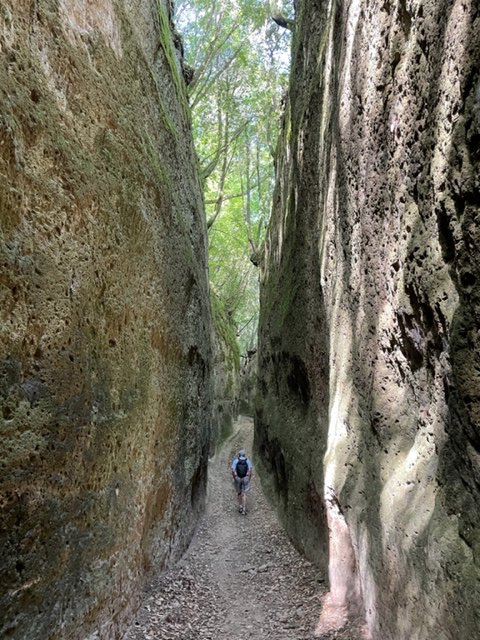
The idea of Bitter Maremma, first book in the Leah Contarini series, came to mind after hours of walking the isolated and at times eerie Etruscan trails of lower Tuscany. I was inspired by the character of the landscape itself.

If Two of Them Are Dead was inspired by hearing about religious artworks lost during the Second World War and by thinking about what it means to be in a community. An imagined murder (or two!) may compell the plot of my mysteries, but I like to set the deaths in a matrix of community, friendships (current and past), love relationships (current and past), foods we eat, work people do, and animals, illness: all the vicissitudes people go through by just living their actual lives. — And the more news I watch, the more I understand that this is exactly the matrix of murder.

I was compelled to write the third book in the series (The Spaces Between the Threads, 2024), after listening to the story of a Tuscan friend who hid from the Germans in the caves of lower Tuscany during the occupation of WWII. Stories.

We are homo narrans. We’re a troubled, loving, wise, foolish, erratic, confused, happy, goofy, dangerous bunch who move through the valleys or mountains or plains where we live, wandering around our community, all telling stories in one way or another. Sometimes our stories come in the form of gossip, sometimes in the form of jokes, sometimes in books. And by the unique combination of events/stories in each life, each of us becomes a matrix of stories, like matryoshka, the Russian nesting dolls.

Books

READING:

Maya Arad’s The Hebrew Teacher; Dante’s Inferno; and Italo Calvino’s Fiabe Italiane

The Calvino book is a treasure in these difficult days the world is having. I’ve always liked folktales, but Calvino’s collection, translated from dialect to Italian, has retained a sense of region. True to the way of folk literature, the collection of Calvino’s stories is by turns wonderfully funny, profoundly wise, and, faithful to the genre, powerfully imaginative.

I mention 3 books, but I am part way into several books, which I keep on the stand near my favorite chair. I’d like to say that I never watch movies, never scroll on my phone, but it’s not true – especially if I’m ill. On those days, I can become obsessed with the tortuous plots and fast action of Korean historical films.

WRITING:

The third book in my Leah Contarini Series, The Spaces Between the Threads, is out in paperback and Kindle from Amazon, Barnes & Noble etc. so I am at work on the next book – a new series also set in Italy, but Venice this time. And I’ve promised myself at least one new poem a week, to keep alert to the various possibilities of language.

QUOTE TO REMEMBER:

Don’t look back; you’re not going that way.

Venice and Florence, Italy

Late November 2024.

Back in Italy, I’ve visited friends in Venice, and am now working on the next mystery in Florence. Surrounded by so much beauty, I have to discipline myself to work until noon morning before I can go out for a long walk.

I’m in the rewrite stage of the book. I finished the initial draft months ago, and am now going through it again, struggling to make the book to stay in the confines I initially gave it.

Do other writers get blindsided by new scenes that appear out of nowhere; new characters who peek in the windows, new landscapes that offer themselves?

What is this wild-spring stage of bursting ideas that can come anytime of year, enticing you to to follow new roads?

New Year

One I Forgot to Send!

Happy New Year – in the hope that this will be a healthy year under the guidance of smart and brave leaders and citizens.


I migliori auguri per un felice e sano anno nuovo e per leader e cittadini saggi e coraggiosi


Finding My Way Back Through the Internet

Half a year ago in Rome, my computer, with all my new work, all my addresses (land and computer), all my passwords, my study of Dante’s Inferno, a couple books, and my most beloved pajamas were stolen. My back-up disk was in the U.S.; I don’t use the Cloud; I had no way to retrieve my passwords; and I wasn’t headed home for months.

Over the following months, I tried to piece things back together on a borrowed computer. Worst was the loss of my new work – pages of a new memoir, which I still don’t know if I can replicate in the way I had written them. In a voice not tainted by frustration.

It’s taken me a long while to buy a new computer and begin to reestablish what I lost.

The strange thing is that in the mix of emotions I felt after the theft, one emotion during the ensuing past months has been a sense that I am lighter than I was before. I’ve felt freedom from the way the computer always wants more of me, wants me to scroll, and read useless clips of news, and order books and clothes, send photos and chat with friends, promote and market myself and my books.

My computer kept telling me to be important — and I’m not. I write poems, essays, and mysteries. Some people like my work, some don’t. I keep writing; I’ve found ways around the theft, but I’m also thankful that because of two thieves, I’ve gotten the monkey off my back.

The Writer and the Liminal State

I began my trip to Israel on a Thursday morning. After an easy two-hour shuttle ride to the airport, I checked my bag, breezed through security, and walked straight to the gate.  

Flight delayed…Flight cancelled.  Delta Help Desk handed me a coupon for a hotel that night and rerouted me on next day’s flight to Charlotte NC and from Charlotte to JFK, where I could catch the late-night flight to Tel Aviv.  

Alone for a month before the trip, I had been working hard to finish the third book of my Leah Contarini Mystery Series. During that month, I was at the computer every day, excepting an hour’s walk through the luscious cold of a Bear River Range winter and the hour it took me to shovel the daily snowfall from our driveway and sidewalks.

My work was done. I had been given a hotel room; I had a flight. I had no heavy luggage to wrangle.  I began to feel lighter. The weight of the previous month’s tension and tight muscles caused by the intense work of finishing the manuscript had dissipated and seemed inconsequential. I left the airport for the hotel feeling light and free. Free to let my mind roam. 

      The following morning, waiting outside in the crisp air for the shuttle back to the airport, I met a woman. She was an Hispanic woman from Miami, dressed in chic clothing. Her hair and makeup were professionally done, her glasses chosen to enhance her fine face, and she wore discreet gold on both wrists.  We were standing near each other at the top of the steps, staring out at the snow-covered mountains, when she turned to me and said, “This is the first time I’ve ever seen snow.” 

Since I was accustomed – winter after winter – to shoveling so much snow it made 6-foot walls down each side of our driveway, her words astounded me. Someone who had never seen snow!

I know of course that there are millions of people in the world who have never seen snow. But it had been a long time since I spoke with someone who was seeing it for the first time, and there was something in the way she was looking at the mountains that I couldn’t immediately identify. The significance of snow appeared to mean more to her than just the new experience of seeing it. 

I asked if she were moving to the West.  She hesitated, and as I waited for her response, I watched her face. She was worried. 

It turned out she was a semi-truck driver. Her usual route was Miami, Texas, Southern California, and back again, but she’d been reassigned. She was on her way to Montana where she would be driving a semi along a northern route, through the mountainous West. I let the thought sit. She had never seen and had never driven in snow.  She had left behind a world she knew and was on the way to a job, a potentially dangerous job. I felt a sudden protective sense toward her and wished I knew more about the sort of courage she possessed to take on that job.

I couldn’t have articulated it at the moment, but I had entered a liminal world. Like the people around me in the airport and on the plane, I had left but had not yet arrived.

A liminal world, simply put, is the place (physical, emotional, metaphorical) a person is during a transitional period. You are “inbetween”. If you’re an adolescent, you’re no longer a child, but you’re not yet an adult; if you’re a bride or a groom, you’re no longer single, but you’re not quite married.  If you’re an immigrant at a citizenship ceremony, you’re no longer an alien, but you’re not quite a citizen. 

It was with that woman’s story that I began to feel how all of us headed for the airport were in a liminal state. I thought of Chaucer. As travelers, all of us on our way to the airport and in the airport were in at the least, the liminal state of a traveler.  We were on the move: moving from airport to plane to airport to plane: situation left vs. situation anticipated. I’d left my American home and was going to my Israeli home. I was gone and yet not arrived.  I had entered this liminal space by leaving a life in the American West and flying toward my very different life in Israel. 

Neither home nor home, hiatus:  not writing, no more orientation by my mountain surroundings and friends, and no more concerns, except basic physical necessities.  All I needed to do was float through the airport or sit on a plane and listen to other people in the same state. We were the modern version of Chaucer’s Canterberry Tales.  I was filled with the excitement of what I would discover in this liminal state.

What I discovered as I moved through the 2 ½ days of the trip were stories: love stories, stories of fear, stories of tragic loss; stories of divorce and reconciliation, stories of food, stories of yearning, stories of freedom children told by running and shouting in the airline hallways; stories about diets, stories about a beauty salon, stories about living in Jerusalem, stories about terrible illness, stories of a loved-one’s death. 

I was floating through the world made small, with a motley crew, all of us existing between what was and what was to come. I listened to their stories; I told mine. I wanted to hear any story any one wanted to tell, and if I hadn’t yet articulated it, I now know that I was being offered a gift any writer desires:  stories laden with new understanding of what makes us human. 

We’re all homo narrans, shaping our lives as we travel.   
The Cave of the Jews

10 May 2022

     Lower Tuscany. I’ve finished work on the second book in my Leah Contarini Mystery and am ready to send it to the press, happy to let them take over. 

 Today, for a break, I decided on research for the next book. S. and I drove the back roads of the thick forests on the border with Lazio, bumping over narrow dirt roads through the high hills. We were looking for the Grotto degli Ebrei, the “Cave of the Jews.”  This is the cave where our friend, Elena, and her family hid from the Germans during Germany’s occupation of Italy in World War II. Elena was 9 when, in November of 1943, she and her family, left their home and went west and north to the farm of gentile friends. Each month they moved to another farm, sometimes barely ahead of the Facists or the Germans, and finally ended in what came to be called the Cave of the Jews in the same forest where we drove today. 

     The forests of this area of Tuscany are like jungles: chestnut, oak, maple, hornbeams crowd each other, thick as grass, and the ground cover of tangled vines, thorny bushes, giant stands of Scotch Broom, overgrown wild roses, and wild raspberry bushes twist together in tight, impenetrable  knots. 

     Like some other local Jewish families fortunate enough to escape in time, Elena’s family was sustained by courageous peasants/farmers who put their lives on the line to protect Jewish families from the German soldiers combing the area to kill or round up Jews for the camps.  

     We stopped at a house deep in the hills and talked to a man who was eating lunch with his family. “The cave is difficult to find,” he explained. “I could take you, but I have to work on my tractor today. It’s hard to find.”

     So, today didn’t work out, but another day it might, and the story of that nine-year-old girl begins to take shape in my mind. 

New Year’s

Happy New Year  in the hope that this will be a healthy year under the guidance of smart and brave leaders and citizens.

שנא טובה (שנייה) בתקייה שזו תהיה שנה בריאה בהדרכת מנהיגים ואזרחים חכמין ואמיצים

I migliori auguri per un felice e sano anno nuovo e per leader e cittadini saggi e coraggiosi